| Clef Verte | EU Ecolabel | |
|---|---|---|
| Nature | Sustainable tourism label for accommodations and restaurants | Official ecological label of the European Union |
| Issued in France by | Clef Verte procedure, audit by a CCI advisor or a qualified consultant | AFNOR Certification |
| Small accommodations | Gîtes and B&Bs explicitly eligible, pricing line for "furnished rentals" | Room-based accommodation: furnished rental to be confirmed with AFNOR |
| Criteria | About one hundred, 7 themes | 22 mandatory and 45 optional (points system) |
| Cost | Public grid: €90 to €360 participation per year in 2027 | On quotation |
| Current standard | 2026, then 2027-2031 | Decision (EU) 2017/175, valid until 31 December 2027 |
Comparison
Accommodation eco-labelClef VerteEU EcolabelSustainable tourismGreenwashing
Accommodation eco-label: Clef Verte or EU Ecolabel?
Which eco-label should you choose for a gîte, furnished rental or B&B: Clef Verte vs EU Ecolabel compared, with costs, audit, duration and the 2026 anti-greenwashing rules.
Équipe Majordia

An accommodation eco-label is a voluntary, third-party-verified certification showing that you are genuinely reducing your impact on water, energy and waste. In France, two eco-labels come up most often for a gîte, a bed and breakfast or a furnished rental: the Clef Verte (Green Key) and the EU Ecolabel. They do not target the same audience, cost the same, or follow the same procedure.
The topic has become more sensitive since 27 September 2026, the date the European anti-greenwashing directive became applicable: writing "eco-responsible accommodation" in a listing or displaying a home-made logo is no longer trivial. This article compares the two labels on verifiable criteria (audience, number of criteria, cost, audit, duration), explains what each one requires of a small accommodation and helps you decide whether it is better to aim for a label or simply to structure your actions.
Last source check: 4 October 2026. This article is for information only and is not personalised legal or tax advice: check the conditions for your situation with the organisation concerned.
What are the main eco-labels for a tourist accommodation?
For a French accommodation, two reference points dominate: the Clef Verte, a sustainable tourism label specific to accommodations and restaurants, and the EU Ecolabel "tourist accommodation", the European Union's official label.
Other schemes exist (network labels such as Gîtes de France, regional charters, international certifications), but their conditions vary and are not detailed here: only the two eco-labels below were checked against their official pages. For an overview of concrete actions before aiming for a label, see our guide on eco-responsible accommodation.
Sources: Clef Verte, Join the label, 2027 price grid, European Commission, Ecolabels.fr. Number of Ecolabel criteria: Majordia calculation based on the annex of the decision.
Is the Clef Verte suitable for a gîte, a B&B or a furnished rental?
Yes for gîtes and B&Bs: according to the label's official page, the Clef Verte is awarded in 2026 to hotels, campsites, youth hostels, tourist residences, holiday villages and centres, B&Bs, gîtes and restaurants. The 2027 price grid even includes a "B&Bs, gîtes and furnished rentals" line. For a furnished rental let on a platform, the label specifies that eligibility depends on the establishment's category (based on its NAF code) and invites you to contact its team if in doubt.
The label claims more than 9,000 establishments in 90 countries under the Clef Verte / Green Key banner, and states that participation is voluntary for everyone.
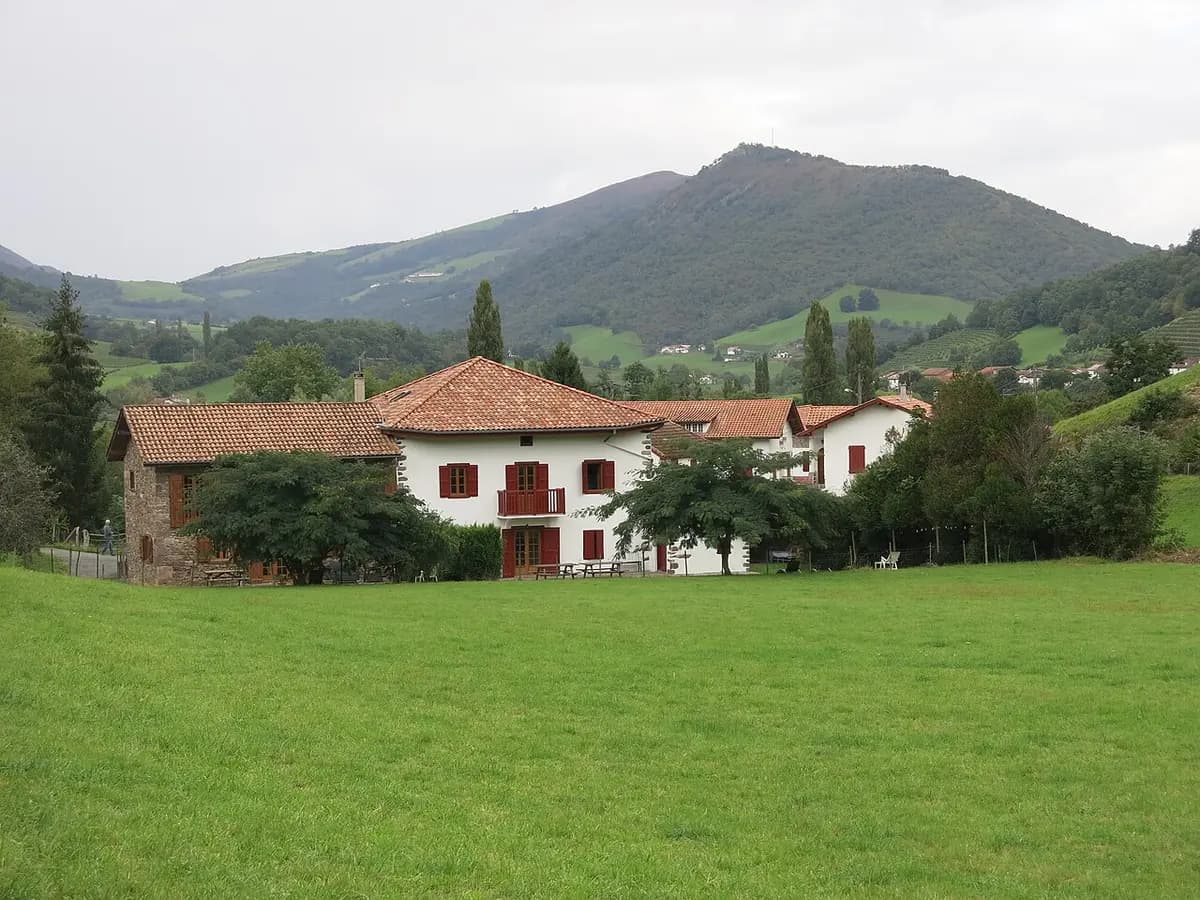
Country gîte in Saint-Étienne-de-Baïgorry (Pyrénées-Atlantiques), photo by Tangopaso, Wikimedia Commons, public domain.
What does the Clef Verte check?
The standard covers seven themes: sustainable management, guest awareness, energy and carbon, water, waste, responsible purchasing and living environment. It includes about one hundred criteria, split between imperative criteria (the baseline required to obtain the label) and recommended criteria (the progression). It adapts to each type of establishment: the criteria for gîtes and B&Bs are not those of a hotel or a campsite.
The criteria are set internationally by the Foundation for Environmental Education and reviewed every five years, with a 2027-2031 standard published for the next period. According to the criteria page (own translation), the requirements include in particular selective waste sorting accessible to guests, a reduction in single-use packaging, monitoring of energy consumption, water-saving devices and more responsible purchasing.
How does the Clef Verte process work?
The label describes six steps and a duration of about one year, depending on your starting point:
- a self-assessment of about one hundred questions, on a platform where creating an account is free;
- an action plan that first addresses the imperative criteria, with documented evidence;
- submission of the application, which commits the establishment under the general terms of participation;
- an external audit of about half a day, carried out by a CCI advisor or a qualified Clef Verte consultant;
- correction of any gaps: if one to five imperative criteria are missing, you have two months to provide the supporting documents;
- labelling, with a plaque, a certificate and a communication kit.
The rules change with 2027. In 2026, the label is awarded for one year (1 January to 31 December) and renewed every year, with about 95% of establishments requesting it again. From 2027, it will be awarded for two years, with an on-site audit every two years and, in the intermediate year, justification of a sample of 12 imperative criteria.
How much does the Clef Verte cost for a small accommodation?
The 2027 grid distinguishes three items. The annual participation fees, invoiced by Teragir, apply to B&Bs, gîtes and furnished rentals: sleeping capacity multiplied by €2.50, with a minimum of €90 and a maximum of €360. Capacity is the number of individual beds, a double bed counting as two. The certification fees, invoiced each year by the certification body, are €75 excl. VAT for small accommodations (at most 20 rooms or 40 beds). The audit fees are due only in the year of an on-site audit: they are not yet set for 2027, but the grid indicates a total duration of 5 hours (preparation, visit, report, follow-up) for a small accommodation.
A simple calculation shows where a typical furnished rental stands. The €90 minimum applies as long as capacity does not exceed 36 beds (36 x €2.50 = €90), so for almost all furnished rentals and gîtes. The recurring cost excluding audit is therefore at least €165 per year (€90 participation and €75 excl. VAT certification). Majordia calculation based on the 2027 Clef Verte price grid; the grid does not specify the VAT treatment of the participation fees.
On top of these fees come the time spent and any investments (tap aerators, efficient bulbs, sorting bins), which vary depending on your property.
Is the EU Ecolabel accessible to a small accommodation?
Possibly, but the question of whether a furnished rental is eligible must be put to the certification body. The European decision defines tourist accommodation services as the provision, for payment, of overnight accommodation in rooms with at least one bed, with private or shared sanitary facilities. It does not expressly mention furnished rentals or gîtes: if you rent a whole dwelling, ask AFNOR Certification whether your case is admissible before incurring any costs.
Here is what the official text and institutional pages allow us to state:
- Framework: Decision (EU) 2017/175 of 25 January 2017, whose period of validity was extended by an amendment of 19 December 2024 until 31 December 2027. The Commission indicates that a revision of the criteria is under way, so the requirements may change. Source: European Commission page.
- Issued in France by: AFNOR Certification, according to Ecolabels.fr. This page publishes no prices, and the page Obtenir un écolabel offers to request a quote: so expect a personalised quotation.
- Areas covered: general management (environmental management, staff training, guest information, monitoring of consumption), energy, water, waste and wastewater, and other criteria such as the promotion of eco-friendly transport.
How many criteria and what points system?
According to the annex of the original decision (adopted text, archived on legislation.gov.uk), the criteria numbered 1 to 22 are mandatory and those numbered 23 to 67 are optional, i.e. 22 mandatory and 45 optional criteria. Majordia calculation based on the numbering of the annex.
To be eligible, the accommodation must meet all the mandatory criteria and score at least 20 points on the optional criteria. This threshold is raised by 3 points if you offer catering, by 3 points if you provide green spaces, and by 3 points for leisure or fitness facilities (5 points for a wellness centre open to non-residents). Mandatory criteria include, for example, monitoring consumption, annual preventive maintenance of equipment, water-saving taps, waste sorting and active information for travellers.
The text provides few exemptions for small businesses: the requirement on automatic switch-off of heating, air conditioning and lighting, for example, exempts accommodations with no more than five rooms. The standard remains designed for room-based accommodation, hence the value of checking eligibility before any application.
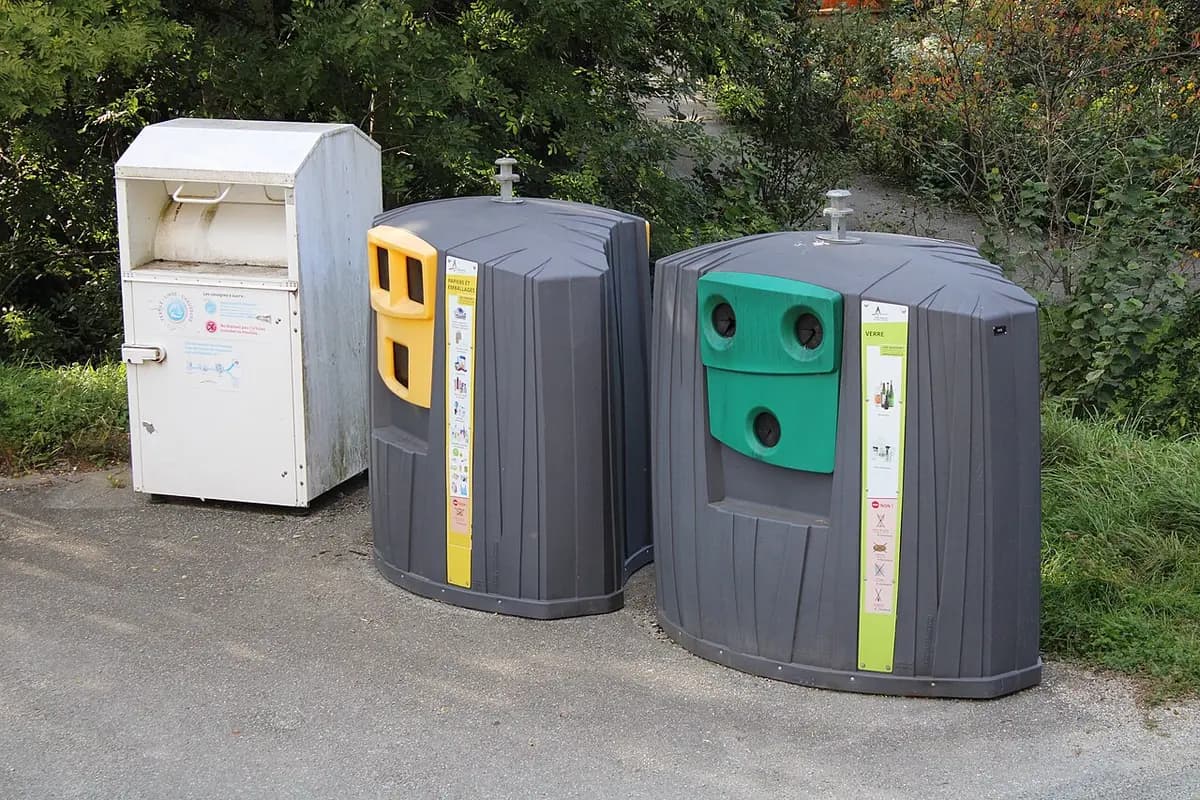
Recycling containers in Césarches (Savoie), photo by Anthony Levrot, Wikimedia Commons, CC BY-SA 4.0 licence.
Clef Verte or EU Ecolabel: which to choose for a gîte or furnished rental?
For a small accommodation, the Clef Verte is the clearest starting point: its pages explicitly mention gîtes, B&Bs and furnished rentals, the price grid is public and the self-assessment is free. The EU Ecolabel makes more sense if you run several rooms, offer catering or want an official European label, and if AFNOR Certification confirms that your property is admissible. This is a methodological opinion, not a rule: each situation should be checked with the organisation.
| Your situation | Option to examine first |
|---|---|
| 1 to 3 furnished rentals, tight budget | Free Clef Verte self-assessment, then decide |
| Gîte or B&B with several rooms | Clef Verte, then an AFNOR quote to compare |
| Hotel, campsite, tourist residence | Both depending on the target audience, AFNOR quote included |
| No budget for a label | Documented actions without a logo, worded with caution |
Do you really need to aim for a label?
Not necessarily. Both labels are voluntary schemes. If your priority is to cut consumption and reassure your travellers, structuring your actions may be enough at first: aerators on taps, efficient bulbs, clearly explained sorting, preventive maintenance. Our article on energy renovation and the DPE of a furnished rental shows how energy weighs on both your running costs and the value of the property, and the one on preventive maintenance helps you keep the maintenance log that the Ecolabel requires.
Why the anti-greenwashing directive changes things since September 2026
Directive (EU) 2024/825 has applied since 27 September 2026 and regulates environmental claims and sustainability labels in business-to-consumer relations. According to the law firm KPMG Avocats (own translation), a sustainability label must rely on a certification scheme (with third-party verification) or be established by public authorities, and a generic claim such as "ecological" requires demonstrating recognised and relevant excellent environmental performance. Source: KPMG Avocats, transposition of the Empowering Consumers directive.
France had not yet transposed the text by the end of September 2026. According to the lawyer Guillaume Leclerc, in an article dated 28 September 2026 (own translation), the bill has been stuck in the National Assembly since 20 February 2026 and the European Commission sent France a formal notice on 28 May 2026. The same article recalls that the French Consumer Code already penalises misleading commercial practices, notably in article L121-2. Source: Village de la Justice.
Attention
This reading is for information only. If you are unsure about the wording of a listing, have it validated by a consumer law professional: to be checked according to your situation, especially as long as the French transposition is not complete.
In practice, for a furnished rental listing, this suggests three reflexes:
- only display logos of labels you actually hold, as described by the issuing organisation;
- replace "eco-responsible accommodation" with verifiable, dated facts ("waste sorting explained in six languages", "efficient bulbs in every room");
- do not create a logo or a "home-made label" that would give the impression of a certification.
How does the welcome book help you keep a label's commitments?
Both labels require you to inform travellers. The EU Ecolabel requires the information to be given actively, at reception or in the accommodation, orally or in writing: environmental policy, energy and water savings, waste sorting, low-impact transport, local sites and shops, plus a satisfaction questionnaire. On the Clef Verte side, guest awareness is one of the seven themes and sorting must be accessible to travellers.
A well-kept welcome book is the natural medium for these instructions. With the Majordia digital welcome book, each property has a booklet accessible by QR code or short link, where you can detail sorting, saving tips and the local guide. Automatic translation into six languages avoids leaving instructions in French only. This does not replace the audit: the booklet only carries the information, and it is up to the organisation to decide whether it is sufficient.
Key takeaways
Information
Clef Verte: gîtes, B&Bs and furnished rentals eligible according to the label's pages, participation of €90 to €360 per year in 2027, certification of €75 excl. VAT per year for a small accommodation, two-year labelling from 2027. EU Ecolabel: 22 mandatory and 45 optional criteria, 20 points minimum, criteria valid until 31 December 2027, issued by AFNOR Certification on quotation, eligibility of a furnished rental to be confirmed. Since 27 September 2026, sustainability labels must rely on verified certification and generic claims such as "eco-responsible" require evidence.
FAQ
Is an eco-label mandatory to rent out a furnished tourist rental?
No. According to the official pages, the Clef Verte is a voluntary scheme and the EU Ecolabel is a voluntary label. Your rental remains subject to the usual obligations (declaration, tourist tax, DPE), which are independent of any eco-label.
How long does it take to obtain the Clef Verte?
The label states that the application process takes about one year, depending on the starting situation. If your environmental commitment is only just beginning, it advises taking more time before submitting the application. Starting with the free self-assessment lets you measure the gap.
How much does the EU Ecolabel cost for an accommodation?
No price is published on the Ecolabels.fr reference page: fees depend on a quotation issued by AFNOR Certification. Request it before any investment, specifying the nature of your property.
Can I write "eco-responsible accommodation" in my listing without a label?
This claim is a generic one. Directive (EU) 2024/825, applicable since 27 September 2026, requires demonstrating recognised excellent environmental performance for such claims. Prefer precise, verifiable facts, and check your wording against your situation.
Does the digital welcome book count as evidence for a label?
It can serve as a medium for informing travellers, but it is the certification body that assesses the evidence. Show it the booklet, its sections and its translations, and keep the supporting documents for the actions described (invoices, maintenance logs, consumption readings).
Conclusion: choose a label, or start with measurable actions
The best starting point is an honest self-assessment: it costs time, not money, and shows whether a label is realistic. If you aim for one, the Clef Verte is the best-documented path for a gîte or furnished rental, the EU Ecolabel is compared on quotation, and in every case your listings should remain factual. To inform your travellers without printing new instructions, you can discover the digital welcome book or compare the plans on the Pricing page.
Image credits. Cover: houses fitted with solar panels in the Netherlands, photo by Uitbundig, Unsplash, Unsplash licence. Illustrations: Tangopaso (public domain) and Anthony Levrot (CC BY-SA 4.0), via Wikimedia Commons; images converted to WebP format and resized.
All articles
Share:
Free trial
Ready to switch to a digital booklet?
1 month free: card offered at signup (optional). With a card, your complimentary QR code ships free to you during the trial. Your booklet is ready in minutes.
Create my booklet for free


.jpg)
