| Indicator | Value | Source |
|---|---|---|
| Overnight stays in collective accommodation, May to August 2026 | 260.5 million (+1.1%, or +2.8 million) | INSEE Focus no. 387, September 29, 2026 |
| Of which hotels | 92.0 million (+1.7%) | INSEE Focus no. 387 |
| Of which campsites | 126.5 million (+1.1%) | INSEE Focus no. 387 |
| Resident guests | +1.6%, accounting for the entire increase | INSEE Focus no. 387 |
| Nights booked via platforms in the EU, 2025 | 951.6 million (+11.4% year on year) | Eurostat, April 1, 2026 |
| Nights via platforms in the EU, Q2 2026 | 258.8 million (+5.3% year on year) | Eurostat, October 2, 2026 |
Guide
Tourism in France 2026INSEEEurostatForeign visitorsShort-term rental
Tourism in France in 2026: What to Take Away
Record summer 2026 in hotels and campsites, big cities down, platforms slowing: what the INSEE and Eurostat figures mean for a host.
Équipe Majordia

Tourism in France in 2026 is doing well, but not everyone benefits in the same way. According to INSEE, the French national statistics institute, hotels, campsites and other collective accommodation recorded 260.5 million overnight stays between May and August 2026, the highest level in fifteen years. The increase comes from French guests, foreign visitor numbers are flat, and big cities are slipping while rural areas gain ground.
For a short-term rental host, these figures cannot be read at face value: the INSEE survey does not measure bookings made on peer-to-peer platforms. This article separates what the official statistics actually say, what they do not say, and what you can infer for your next season, with every figure dated and linked to its source.
Sources last checked: October 6, 2026. INSEE's July and August 2026 data are provisional. The reading and interpretation passages are analyses by the Majordia editorial team, not conclusions of the bodies cited.
What do INSEE and Eurostat say about the 2026 season?
Two sources complement each other: INSEE measures hotels, campsites and tourist residences, while Eurostat counts the nights booked on Airbnb, Booking and Expedia. Neither covers all short-term rentals, but together they show which way the market is moving.
Sources: INSEE Focus no. 387, Eurostat, 2025 nights, Eurostat, second quarter 2026.
Why is summer 2026 described as a record?
Because occupancy in collective accommodation "exceeds that of the 2025 season, already the highest in 15 years", writes INSEE (our translation). The institute adds that this increase comes "despite increased competition from peer-to-peer bookings" (our translation): platforms are gaining market share, and yet hotels and campsites are still growing.
The breakdown by type of stay matters: campsites remain in the lead with 126.5 million overnight stays, ahead of hotels (92.0 million). Only other collective tourist accommodation dipped slightly (-0.4%).
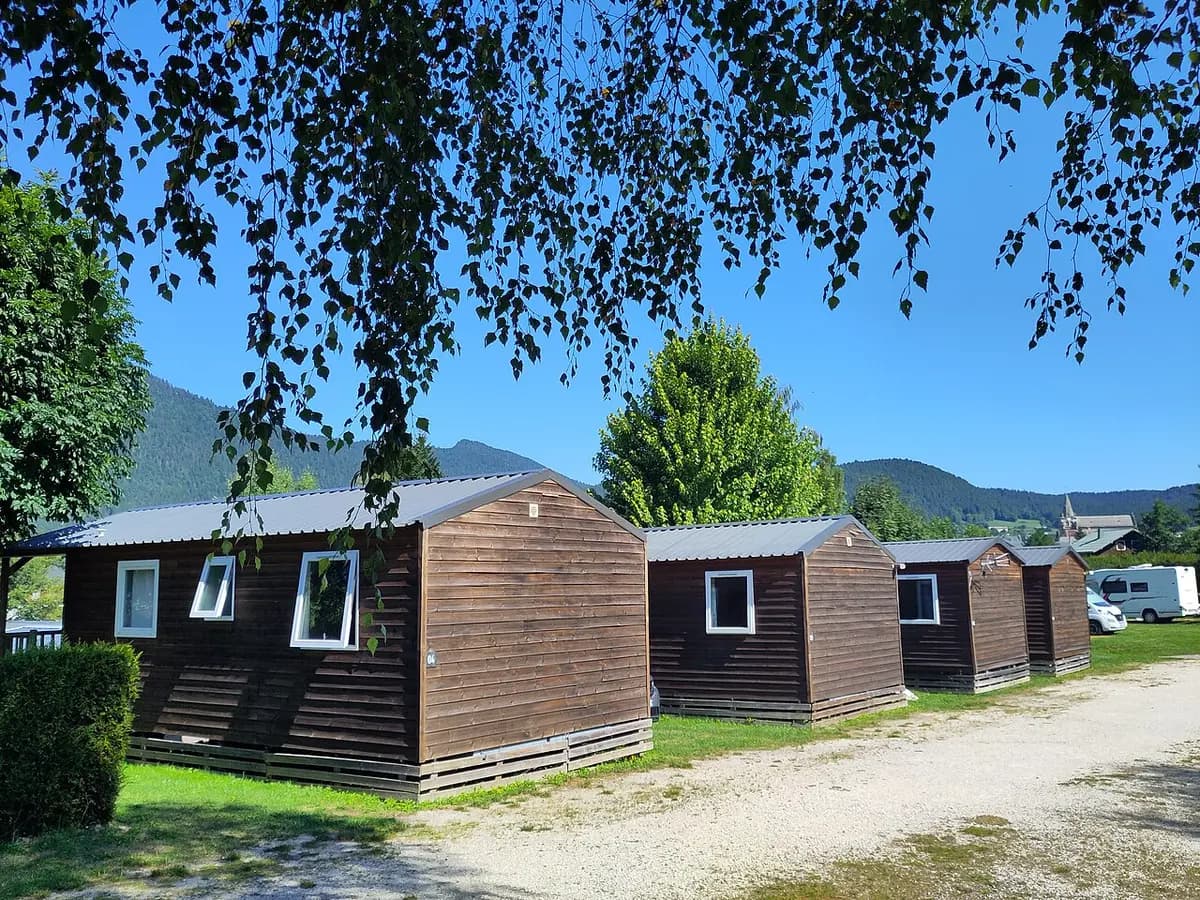
Mobile homes at a campsite in Autrans (Isère), photo by Exilexi, Wikimedia Commons, CC BY 4.0 licence.
What is the limit of these figures for a host?
The INSEE survey covers hotels, campsites and other collective tourist accommodation. The institute says so in plain terms in its methodological note: "Occupancy generated by peer-to-peer booking platforms is not measured in this survey." (our translation) A furnished rental listed on Airbnb or Booking is therefore not included in the 260.5 million overnight stays.
That is the first rule of interpretation: the summer figures tell you what climate your guests are travelling in, not how many nights your property sold. For the platform trend, you need to turn to Eurostat, which consolidates the data supplied by Airbnb, Booking and Expedia.
Who travels this summer: mostly French or foreign visitors?
Mostly French. Resident guests account for "more than two summer nights out of three" (our translation) in collective accommodation and on their own explain the 2.8 million additional overnight stays in 2026. Non-resident guests, for their part, are flat over the season and even fell in August.
The share of non-residents stands at 31.5% of overnight stays in 2026, against 31.8% in 2025. It remains markedly higher in hotels (39.9%) than in campsites (29.6%) or other collective accommodation (19.0%).
Which nationalities dominate in hotels?
In French hotels, the United States remains the top foreign country with 5.4 million overnight stays in 2026, ahead of the United Kingdom (4.3 million) and Germany (3.9 million). Next come Belgium (2.8 million), Italy (2.3 million), the Netherlands (2.2 million) and Spain (2.0 million).
Trends are mixed: Germany (+3.9%), Belgium (+3.1%), the Netherlands (+3.0%) and the United Kingdom (+1.2%) are up, while Spain (-8.5%) and Italy (-3.0%) are clearly contracting. Hotel nights by Chinese (-9.0%) and Japanese (-10.8%) guests are also down, and remain well below their pre-pandemic level.
And in campsites?
Foreign guests there are almost exclusively European. The Dutch remain the most numerous (11.8 million overnight stays, -3.1%), followed by the Germans (9.7 million, +1.3%), the Belgians (4.8 million) and the British (4.4 million).
Where is occupancy rising, and where is it falling?
The coast, the mountains and rural areas are gaining overnight stays, while big cities are losing them. This is the clearest territorial message of the study.
| Area | Change in overnight stays, summer 2026 | INSEE note |
|---|---|---|
| Coast | +1.4% (106.3 million) | North and west in the lead: +5.6% and +5.0% |
| Mediterranean seaboard | +0.3% | Drop in August |
| South Atlantic seaboard | -2.3% | July wildfires, but a noticeable drop already in June |
| Mountain ranges | +1.3% (45.0 million) | |
| Dense urban areas | -3.9% (-2.5 million) | Non-resident guests -7.7% |
| Intermediate urban areas | +2.1% (+1.6 million) | |
| Rural municipalities | +3.2% (+3.7 million) | Driven by campsites |
Source: INSEE Focus no. 387, September 2026. Provisional data for July and August.
INSEE considers that the drop in big cities is probably linked to the summer's heatwaves. For the South Atlantic, the institute urges caution: the wildfires "probably explain only part of the decline" (our translation), since the drop was already visible in June.
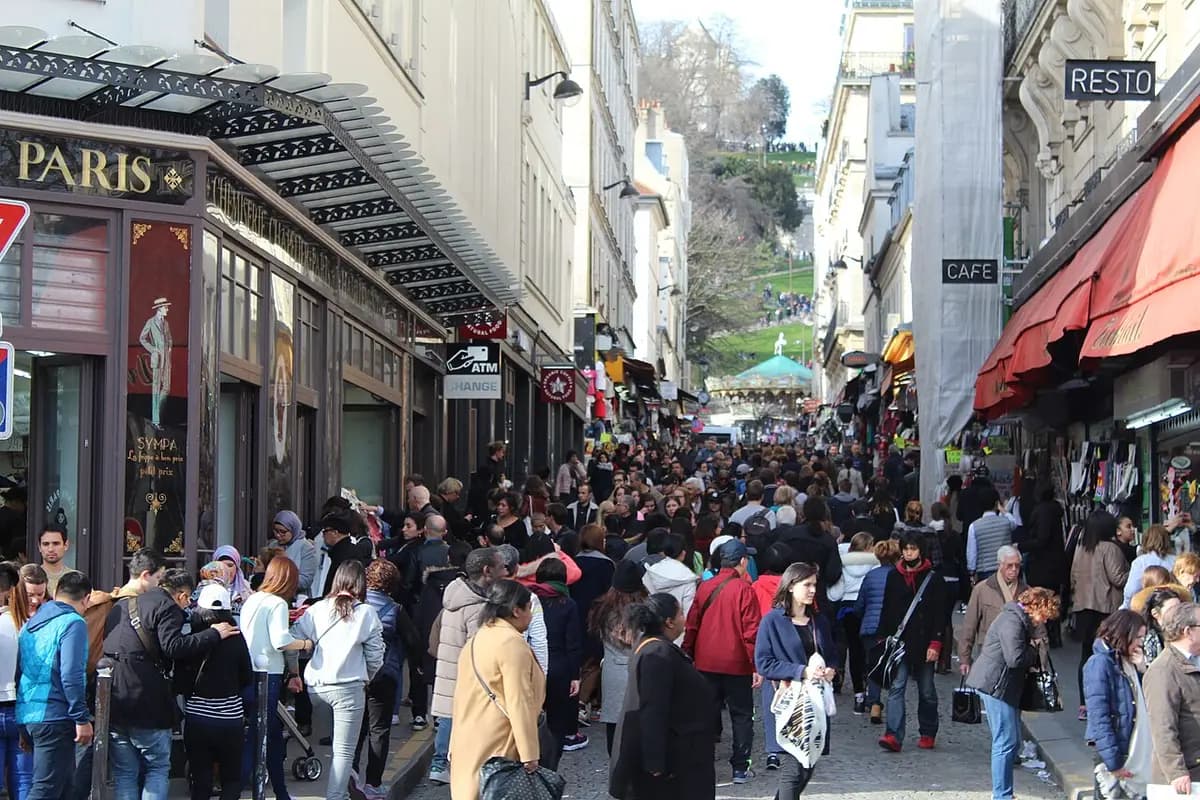
Rue Steinkerque, Paris 18th arrondissement, photo by Chabe01, Wikimedia Commons, CC BY-SA 4.0 licence; undated illustrative image.
What do the booking platforms say?
They keep growing, but the pace is slowing. According to Eurostat, nights booked via Airbnb, Booking and Expedia in the European Union reached 951.6 million in 2025, which is 11.4% more than in 2024 and 32.4% more than in 2023. Over the following quarters, annual growth came in at 8.7% (Q3 2025), 10.9% (Q4 2025), 9.7% (Q1 2026) and then 5.3% (Q2 2026, or 258.8 million nights).
On these series, the second quarter of 2026 is therefore the weakest growth of the last four published quarters. This is an observation by our editorial team based on Eurostat releases, to be confirmed by the coming quarters: one quarter does not make a trend.
Does France carry weight in these bookings?
Yes. In the third quarter of 2025, Provence-Alpes-Côte d'Azur ranks third among EU regions with 16.9 million nights booked via platforms, behind the Croatian Adriatic coast (27.7 million) and Andalusia (19.5 million). Of the 20 most visited regions that quarter, 6 are French (5 Spanish, 4 Italian). In the first quarter of 2026, the Rhône-Alpes region ties with the Canary Islands for first place (8.8 million nights each).
Sources: Eurostat, 2025 and Q3 2025, Eurostat, Q3 2025 national, Eurostat, Q1 2026 and Q2 2026.
Do furnished rentals really compete with hotels?
INSEE's regional data suggest so. In Nouvelle-Aquitaine, between 2019 and 2024, nights booked via platforms in furnished tourist rentals grew by 11% a year on average, against -0.3% for hotels and +1.7% for campsites. The region recorded nearly 20 million nights in 2024 (19,822,581), and 73% were booked by tourists living in France, 27% by foreign tourists.
Nationally, INSEE indicates that the appetite for furnished tourist rentals is even stronger: +14% a year on average between 2019 and 2024. The pattern matches summer 2026: solid domestic demand, which benefits peer-to-peer rentals as much as campsites.
Source: INSEE Flash Nouvelle-Aquitaine no. 131, December 3, 2025, based on Eurostat's experimental data (Airbnb, Booking, Expedia Group, Tripadvisor).
What does this mean for a short-term rental host?
These statistics do not predict your occupancy rate, but they point to four decisions. What follows is the editorial team's reading, to be checked against your own booking data.
- Focus on French demand. If resident guests are driving growth, last-minute stays, weekends and the shoulder season matter more. An open calendar and simple arrival rules count for more than promises of exoticism.
- Do not count on a rebound in foreign visitors. Non-resident numbers are flat, but they remain essential, especially for hotels (close to 40% of overnight stays). If your property hosts British, German, Dutch or Belgian guests, a welcome book in their language is a comfort, not a gimmick.
- In cities, build in pricing flexibility. A 3.9% drop in overnight stays in dense urban areas, with non-residents at -7.7%, makes the calendar more sensitive. Hosts in big cities can look at minimum stay lengths and dynamic pricing.
- Look beyond the big destinations. Rural areas are up 3.2% and intermediate urban areas 2.1%. A property in a small town or the countryside is positioned on growing demand, provided it is well described on the platforms.
Is business travel coming back?
A little. INSEE notes that business travel is up 7.6% in 2026 in collective accommodation excluding campsites, after several years of decline. It remains 16 million overnight stays below its 2019 level, however, a 36% drop in seven years. For properties near train stations or business areas, the workation and business stays segment deserves a second look, without treating it as a promise.
How can you adapt your welcome to international guests?
The nationalities rising in French hotels in 2026 are German, Belgian, Dutch and British, with Americans still leading in volume. In a welcome book, that translates into three priority languages: English, German and Dutch, plus Spanish and Italian if you host travellers from southern Europe. Majordia automatically translates your welcome book into six languages (French, English, German, Spanish, Italian, Dutch) and displays it in the traveller's language; do review sensitive instructions such as access or safety. For foreign travellers, the same page can bring together the practical information about the property: wifi, door code, contacts and emergency numbers.
Astuce
If you manage a property for both French family guests and foreign guests, cross-check these figures with your own data: the origin of your guests over the last 12 months says more than any national average.
Key takeaways
Information
- Summer 2026 (May to August) totals 260.5 million overnight stays in hotels, campsites and other collective accommodation, the highest level in 15 years according to INSEE (July and August data provisional).
- The increase is driven entirely by French guests (+1.6%): foreign visitor numbers are flat.
- Big cities are down (-3.9%), while rural areas (+3.2%) and the coast (+1.4%) are up.
- INSEE does not measure peer-to-peer platforms. Eurostat shows they are still growing (+5.3% in Q2 2026 in the EU), but more slowly than in 2025 (+11.4%).
- Tailor your welcome to French demand and to the main foreign guest groups (British, German, Dutch, Belgian) rather than to a national average.
FAQ
Is tourism in France up in 2026?
Yes for collective accommodation: INSEE records 260.5 million overnight stays from May to August 2026, which is 1.1% more than in 2025, with July and August data still provisional. This statistic does not include rentals booked on peer-to-peer platforms.
Are Airbnb rentals included in INSEE's figures?
No. INSEE's occupancy survey covers hotels, campsites and other collective tourist accommodation, and the institute states that peer-to-peer booking platforms are not measured in it. Eurostat publishes separate data on nights booked via Airbnb, Booking and Expedia.
Are foreign tourists coming back to France?
No rebound in 2026: non-resident occupancy is stable over the summer season (31.5% of overnight stays against 31.8% in 2025) and fell in August. German, Belgian, Dutch and British guests are up in hotels, while Spanish, Italian, Chinese and Japanese guests are down.
Are big cities losing tourists?
Dense urban areas lose 3.9% of overnight stays over summer 2026 in collective accommodation, with -7.7% for non-resident guests. INSEE sees this as a probable consequence of the heatwaves, without asserting it.
Are platform bookings slowing down?
The pace is slowing: Eurostat counts 258.8 million nights in the second quarter of 2026 in the European Union (+5.3%), against +8.7% in the third quarter of 2025 and +9.7% in the first quarter of 2026. A single quarter still needs to be confirmed over time.
What should I do with these figures for my property?
Use them as a barometer, not a forecast. Compare them with the origin of your guests over 12 months and with your municipality's calendar, then adjust the minimum stay, rates and the languages of your welcome book.
Conclusion: read the market before setting your rates
The 2026 season confirms that tourism in France rests on resident demand, that areas outside the big cities are gaining ground and that platforms are growing more slowly. For a host, the challenge is to welcome two audiences well: French guests who book close to the date, and European visitors who expect information in their own language.
If you want to save time on that second point, Majordia's digital welcome book opens with a QR code, is automatically translated into six languages and updates without reprinting. Plans are detailed on the Pricing page. To compare booking channels, also read our comparison of Airbnb, Booking and Abritel.
Sources last checked: October 6, 2026.
Image credits. Cover: beach in Saint-Malo, photo by Xavier Foucrier, Unsplash, Unsplash licence. Illustrations: Exilexi (CC BY 4.0) and Chabe01 (CC BY-SA 4.0), via Wikimedia Commons; images converted to WebP and resized.
All articles
Share:
Free trial
Ready to switch to a digital booklet?
1 month free: card offered at signup (optional). With a card, your complimentary QR code ships free to you during the trial. Your booklet is ready in minutes.
Create my booklet for free


