
Do you let your flat on Airbnb in Paris or its suburbs? A study published on 5 November 2026 by L'Institut Paris Region, the planning agency of the Île-de-France region, shows that holiday letting has never been so active around Paris: 16.7 million nights in 2025, more than in 2024, the year of the Paris Olympic Games. It also shows that in Paris, half of all listings exceeded 90 booked nights, the cap for a main residence since 1 January 2025.
These figures do not change the law. They do, however, show where local councils will look first, what a home lets for today, and why the 90-day check is becoming a real issue for a host in Paris.
This article is based on the Note rapide no. 1072 by L'Institut Paris Region (a short research paper, November 2026, read in full), the City of Paris page on the rules for furnished holiday lets (updated 25 March 2026), the service-public.gouv.fr page on letting your main residence as a furnished holiday let (checked 21 May 2026) and the French Directorate-General for Enterprise (DGE) page on furnished holiday lets.
Sources last checked: 7 November 2026. The study's figures are estimates drawn from Airbnb listings; the rules quoted must be checked against your own situation and your town.
What does the November 2026 study say about Airbnb in Île-de-France?
The study by L'Institut Paris Region concludes that after the 2024 Games, holiday letting is not falling in the Paris region: nights booked on Airbnb rose again in 2025. The title of the paper sums it up: "after the Paris Games, the party goes on?" (own translation).
The key figures of the paper, all drawn from AirDNA data on Airbnb listings only:
| Indicator | 2025 | Comparison |
|---|---|---|
| Active Airbnb listings in Île-de-France | 139,400, of which 51% in Paris | 168,400 in 2024 |
| Booked nights in Île-de-France | 16.7 million | nearly 16 million in 2024, +36% since 2023 |
| Booked nights in Paris | more than 8.9 million | just over 8.3 million in 2024 |
| Entire homes let for more than 120 days in the year | 52,900, of which 55% in Paris | twice as many as in 2019 |
| Booked nights per active listing (median) | 97 | 84 in 2023, 73 in 2024 |
| Share of listings in the outer suburbs (grande couronne) | 20% | about 9% in 2017 |
An "active" listing, as defined by the study, is a listing that received at least one booked night over the period. L'Institut Paris Region states that its figures "should be considered as lower bounds" (own translation): they exclude other platforms, aparthotels, listings for "bail mobilité" (a French short-term tenancy) and unusual accommodation.
The number of listings fell between 2024 and 2025, but nights went up. According to the study, the drop mainly comes from rooms in shared homes and occasional lets (fewer than 121 days a year) disappearing after the Games. Homes let all year round, on the other hand, are growing.
Why are homes let "all year round" at the heart of the issue?
A home let "all year round", in the study, is an entire home booked for more than 120 days in the year: in French law, this threshold marks the end of the status of a main residence let occasionally. These homes carry more and more weight in the market.
According to the paper, in 2025 they account for:
- 38% of Airbnb listings in Île-de-France, a record;
- 69% of nights booked on Airbnb in the region, compared with 56% in 2018.
In Paris, the study counts more than 29,000 homes let for more than 120 days in 2025, over 10,000 more than in 2023: the highest level ever observed. They make up nearly 41% of Paris listings and 72% of nights booked in the capital.
For a host, the practical conclusion is simple: local authorities will focus their efforts on these homes, because they are the ones taking housing off the long-term rental market. The author of the paper, Emmanuel Trouillard, writes that it is now up to "local authorities to make use of the (new) tools at their disposal" (own translation), while pointing to the question of the means available for enforcement.
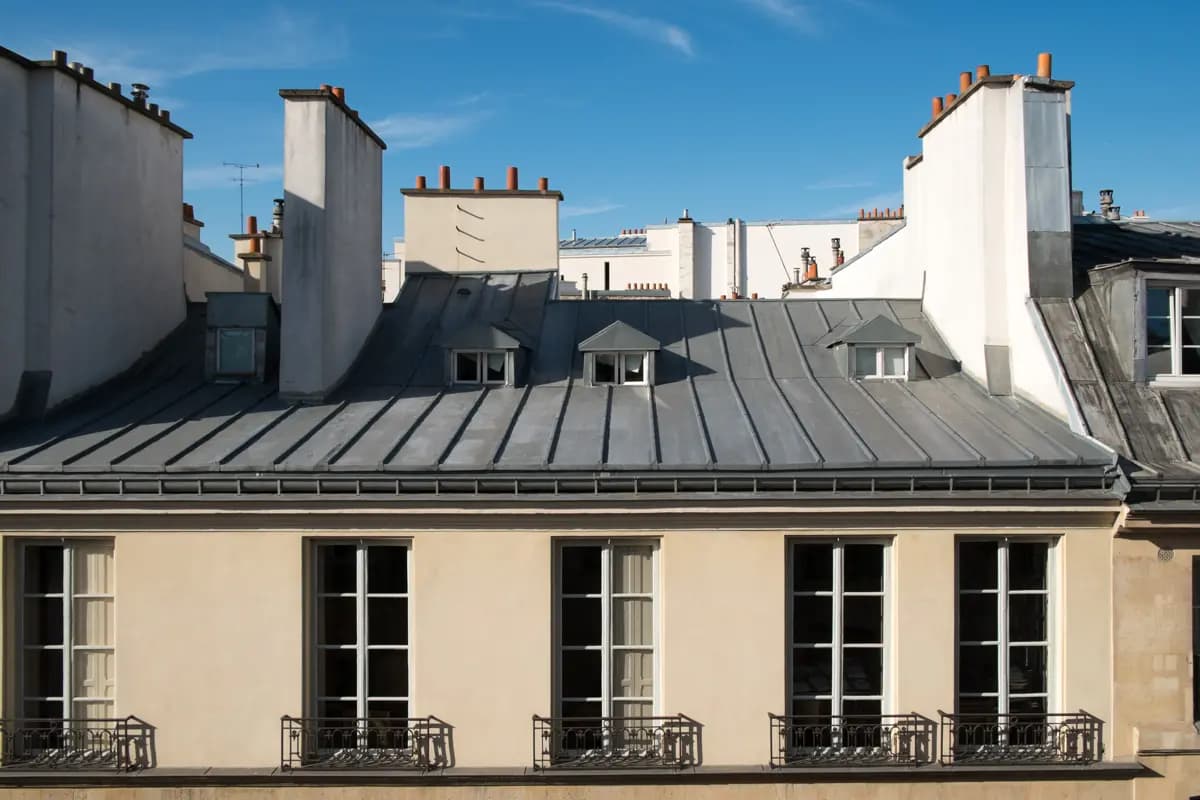
Rooftops of rue Danielle-Casanova, Paris. Photo: Ben Garrett, Wikimedia Commons, CC BY 2.0 licence.
What does "half of all listings above 90 nights" mean in Paris?
In Paris, a main residence cannot be let as a furnished holiday let for more than 90 days a year since 1 January 2025, compared with 120 days before. The study notes that in 2025, half of Paris listings exceeded 90 booked nights and are therefore, in its words, in a "possibly illegal situation" (own translation).
"Possibly", because a listing above 90 nights is not necessarily illegal. The cap applies to the main residence. A second home can be let all year round in Paris if it has obtained a change-of-use authorisation with compensation, a heavy and costly procedure described on the City's page. According to service-public.gouv.fr, the cap can also be exceeded for professional obligations, health reasons or force majeure.
What the City of Paris says about penalties (page updated 25 March 2026):
| Breach | Maximum fine |
|---|---|
| Main residence let for more than 90 days a year | €10,000 per year of excess |
| Second home let without a change-of-use authorisation | €100,000, plus a daily penalty of up to €1,000 per day and per m² |
| Commercial or craft premises let without authorisation | €25,000 |
| No registration number | €5,000 |
| Obstructing the officers of the municipal housing department | €2,250 |
The City states that checks are carried out by the sworn officers of its municipal housing department. Service-public.gouv.fr adds that the town can ask the platform, until 31 December of the following year, for the number of days your home was let, and that the platform must deactivate the listing of a main residence once the cap is reached.
Our guide to the 90-day cap for a main residence explains how to keep a night counter and what to do when 90 days are not enough.
Which suburban towns are growing fastest?
Airbnb letting is spreading beyond Paris: according to the study, the outer suburbs account for 20% of listings in 2025, compared with about 9% in 2017. After Paris, the départements with the most active listings are Hauts-de-Seine (15,300) and Seine-Saint-Denis (14,250, compared with 7,100 in 2022).
The towns named in the paper:
- Saint-Denis, the leading town outside Paris with nearly 2,150 active listings in 2025, helped by its merger with Pierrefitte-sur-Seine on 1 January 2025;
- Saint-Ouen (1,290 listings, +700 since 2018), Aubervilliers (+610), Clichy (+520) and Asnières-sur-Seine (+429), north of Paris;
- Boulogne-Billancourt and Montreuil, each with more than 1,500 active listings;
- Ivry-sur-Seine (+405) and Vitry-sur-Seine (+460), to the south-east;
- in the outer suburbs, the Val d'Europe area (Serris…), Argenteuil and Fontainebleau, where supply often more than doubled between 2018 and 2025.
If you let in one of these towns, check with your town hall: the loi Le Meur (the French law no. 2024-1039 of 19 November 2024 on regulating holiday lets) allows towns to lower the main-residence cap to 90 days and to set quotas of authorisations, and, according to the study, every town in a high-pressure housing area can now require a change-of-use authorisation. Our pillar article on the loi Le Meur and the registration of furnished holiday lets covers these tools.
How much does a night on Airbnb cost in Île-de-France?
According to L'Institut Paris Region, the median price of an Airbnb night rose from €32 to €39 per person in Île-de-France between June 2019 and June 2026 (+23%), and from €39 to €56.50 per person in Paris (+43.8%).
The study notes that the price peak of the 2024 Games remained "quite far from the announced jackpot" (own translation), but that the underlying rise has been real since the health crisis. It compares these prices with hotel prices, citing the firm In Extenso: an average of €239 per room in Paris and €105 in the rest of Île-de-France at the end of 2025. The paper's conclusion: despite the rise, price remains one of the strongest selling points of holiday lets.
What you can take from this:
- Compare your price per person, not just per night: it is the unit used in the study, and the one your guest compares with a hotel.
- Do not count on one event to push up your prices all year: the study shows that the effect of the Games was limited.
- In Paris, 90 nights must earn enough: with the cap, every night counts. Our guide to dynamic pricing for 1 to 4 homes helps you place your nights on the most popular dates.

Photo: Louis Paulin, Unsplash, Unsplash licence.
Which rules are coming for hosts in the Paris region?
The next steps are national: a single online registration service, data passed by platforms to towns, and co-ownership buildings with stronger tools. The study presents them as the end of a "fragmented" system, town by town.
A registration number from one place. According to the paper, registration of furnished holiday lets has been mandatory across France since May 2026, with the entry into application of Regulation (EU) 2024/1028 on short-term rental data. A national application, the "API Meublés" (the State's single registration and data platform), is to let owners declare their home and receive a number; the study says its final version "should be operational at the end of 2026" (own translation). In Paris, the number is currently obtained online through the City's service, and the DGE points out that having no number can lead to a civil fine of up to €5,000. Our article on the European transparency regulation explains what platforms pass on.
The co-ownership informed. Service-public.gouv.fr states that if your main residence is in a co-ownership building, you must inform the managing agent (syndic) as soon as you obtain your number; the agent then informs the co-owners at the next general meeting. The study also points out that the law allows, under conditions, a ban on homes let all year round by a double majority rather than unanimously: see our article on bans in co-ownership buildings.
The energy rating (DPE). According to the study, a furnished holiday let must now have a DPE energy rating between A and E to obtain a change-of-use authorisation. Our guide to the DPE for a holiday let sets out the timetable.
Key boxes. In 2025 the City of Paris issued an order banning their installation on street furniture; a key box in breach is removed. Alternatives are listed in our article on banned key boxes.
Tax. The study recalls that the micro-BIC tax regime for furnished holiday lets has been tightened and that many owners will have to switch to the "réel" (actual expenses) regime. The details are in our guide to short-term rental taxation, and the loi Le Meur allowance calculator gives an estimate based on your classification.
What should you do now if you let in Île-de-France?
A host letting 1 to 4 homes in the Paris region can get compliant with five checks, in this order.
- Status of the home. Main residence (you live there at least eight months a year) or second home? Everything else follows from this.
- Your town's cap. 90 days in Paris for a main residence; 120 days by default elsewhere, unless your town has voted for 90 days. Ask your town hall.
- Registration number. Shown on every listing, on Airbnb and elsewhere. In Paris, the City's online service issues it immediately.
- Night counter. Add up the nights from all your platforms, from 1 January to 31 December. The town can ask for these figures until the end of the following year.
- Co-ownership and building rules. Inform the managing agent and reread your co-ownership rules.
The rest is about welcoming your guests. With Majordia, the digital house manual is created for free, without signing up, as a PDF and with one QR code per home; it displays in 6 languages, with no app for the guest to install. You can use it to explain check-in without a key box on the street, the building rules and keeping quiet at night. Majordia does not handle your registration number or your night counter: these steps remain to be done with your town hall.
Key takeaways
Information
- According to L'Institut Paris Region (paper of 5 November 2026), 139,400 active Airbnb listings recorded 16.7 million nights in Île-de-France in 2025, more than in 2024.
- Homes let for more than 120 days a year account for 69% of Airbnb nights in the region; in Paris there are more than 29,000 of them.
- In Paris, half of all listings exceeded 90 booked nights in 2025, the cap for a main residence since 1 January 2025.
- Fines in Paris: up to €10,000 per year for exceeding 90 days, €5,000 without a registration number, €100,000 without a change-of-use authorisation.
- The median price of an Airbnb night was €56.50 per person in Paris in June 2026 (+43.8% since 2019) and €39 in Île-de-France.
- The national registration application (API Meublés) should be finalised at the end of 2026.
FAQ
How many Airbnb listings are there in Île-de-France?
According to L'Institut Paris Region, 139,400 Airbnb listings were active in Île-de-France in 2025, 51% of them in Paris, compared with 168,400 in 2024. These figures only count listings that received at least one booking, and only on Airbnb.
How many days can you let your main residence on Airbnb in Paris?
90 days a year at most, since 1 January 2025, according to the City of Paris. Exceeding it can lead to a fine of up to €10,000 per year. A second home has no day cap, but it must obtain a change-of-use authorisation with compensation.
My listing is above 90 nights: am I necessarily breaking the rules?
No. The 90-day cap applies to the main residence. A home that has obtained a change-of-use authorisation, or an excess justified by professional obligations, health reasons or force majeure, can go beyond this threshold. That is why the study speaks of a "possibly illegal situation".
Does the 90-day cap apply in the suburbs?
Only in towns that have voted for it. Elsewhere, the default cap for a main residence remains 120 days a year in towns that require registration. Check with your town hall: the rules differ from one town to another.
How much does a night on Airbnb cost in Paris?
According to the study, the median price was €56.50 per night and per person in Paris in June 2026, compared with €39 in June 2019. In Île-de-France, it was €39 per person.
Where do you get a registration number in Paris?
Through the City of Paris online service for declaring furnished holiday lets. According to the City, the declaration gives you the number immediately, and this number must appear on every listing.
Record figures, with enforcement to follow
The November 2026 study creates no new rule, but it shows where activity is concentrated: Paris, its inner northern suburbs and homes let all year round. If you let your main residence, keep your 90- or 120-day counter and display your number. Then take care of the welcome: with the Essential plan (free, add-ons à la carte), create your house manual as a PDF and a phone version, with no account needed.
Image credits. Cover: photo "Paris rooftops with chimneys" by Philippe Dehaye, Unsplash (copy on Wikimedia Commons, CC0). Photos in the text: "Rooftops of Rue Danielle Casanova" by Ben Garrett, Wikimedia Commons, CC BY 2.0 licence, and "Brown concrete building during daytime" by Louis Paulin, Unsplash, Unsplash licence.


