
A multilingual welcome book gives the same practical information (access, Wi-Fi, rules, emergencies) in each traveller's own language. In practice, French and English cover the basics, German and Dutch come in as soon as you receive campers or families from northern Europe, and Spanish and Italian complete the picture for city stays.
This guide helps you choose your languages from public data rather than a hunch. It combines the foreign-visitor overnight stays published by Insee, the visitor figures from Atout France and Eurostat, and a regulatory requirement that is often overlooked: the bilingual welcome book for furnished tourist rentals rated three stars and above.
Sources last checked: 11 October 2026. The Insee data for July and August 2026 are provisional. This article is for information only and does not constitute personalised legal advice.
Why offer your welcome book in several languages?
Offering your welcome book in several languages reduces repetitive questions and usage errors (door code, waste sorting, quiet hours), because travellers read each instruction in the language they understand best. It is also a quality signal that is visible from the moment guests arrive.
Foreign demand is massive. According to Atout France, relayed by TourMaG (article of 19 February 2026), France recorded 102 million international arrivals in 2025, 2 million more than in 2024, and international receipts of 77.5 billion euros (+9%). European visitors are among the growing groups, notably Italians, Spaniards, Belgians, the Dutch and Germans.
Platforms also play a part in this flow. According to Eurostat (1 April 2026), European Union travellers spent 951.6 million nights in short-stay accommodation booked online in 2025, 11.4% more than in 2024. These nights include both residents and non-residents: the figure shows the scale of the market, not the share of foreign travellers.
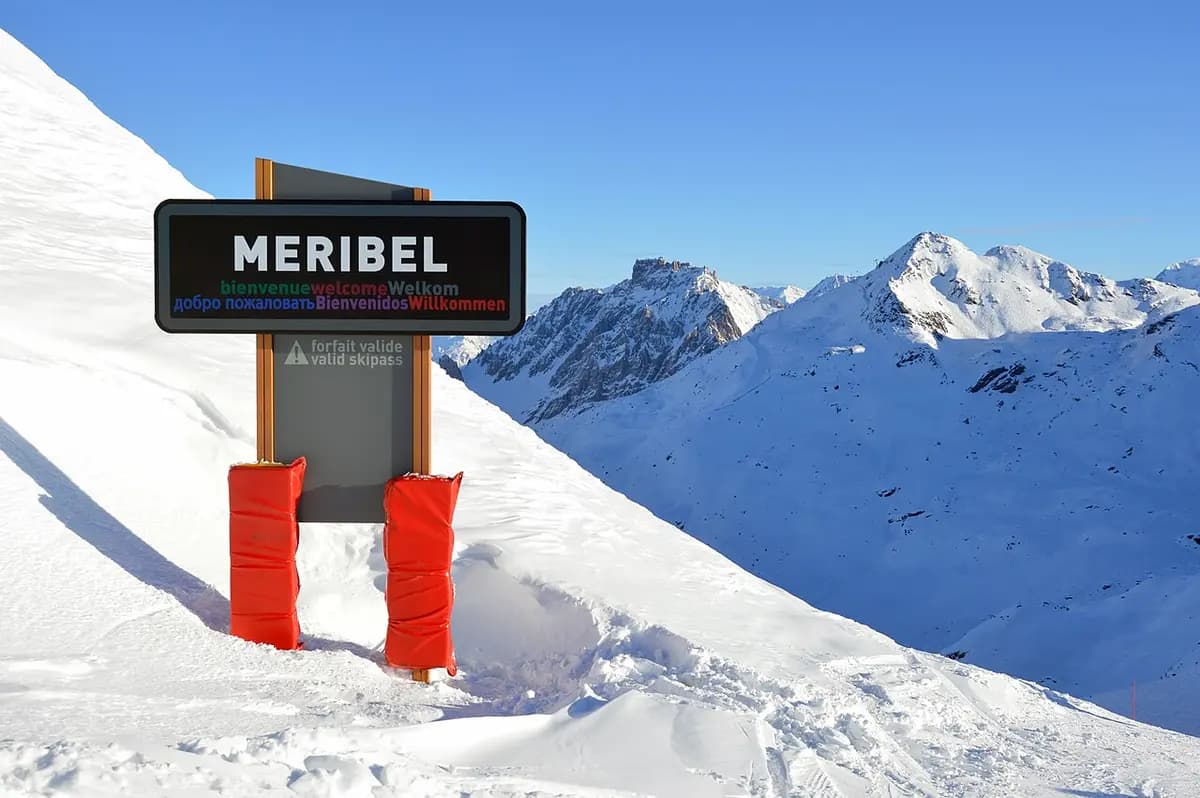
Multilingual welcome sign in Méribel (Savoie), photo by DimiTalen, Wikimedia Commons, CC0 licence; image converted to WebP and resized.
Which nationalities travel most in France?
The largest non-resident groups are Americans, Britons, Germans, the Dutch and Belgians, but their weight depends on the type of accommodation. Hotels attract more Americans and Britons, campsites more Dutch and Germans.
Here are the non-resident overnight stays for the summer 2026 season (May to August), published by Insee in its Focus no. 387 of 29 September 2026, in millions of nights:
| Country of residence | Hotels 2025 | Hotels 2026 | Campsites 2025 | Campsites 2026 |
|---|---|---|---|---|
| United States | 5.3 | 5.4 | not published | not published |
| United Kingdom | 4.2 | 4.3 | 4.6 | 4.4 |
| Germany | 3.7 | 3.9 | 9.6 | 9.7 |
| Belgium | 2.7 | 2.8 | 4.9 | 4.8 |
| Italy | 2.3 | 2.3 | not published | not published |
| Netherlands | 2.1 | 2.2 | 12.2 | 11.8 |
| Spain | 2.2 | 2.0 | not published | not published |
| Switzerland | 1.9 | 1.9 | 2.0 | 2.0 |
| All non-residents | 36.4 | 36.7 | 37.6 | 37.4 |
These figures cover hotels and campsites, not furnished rentals or bed and breakfasts: they are a benchmark, not a measure of your own guests. According to the same publication, non-residents account for 39.9% of hotel nights and 29.6% of campsite nights in 2026.
The most useful way to read these figures is by language. Majordia calculation from Insee, Focus no. 387: Americans and Britons together account for 9.7 million hotel nights out of 36.7 million, or about 26% of non-resident hotel nights. At campsites, the Dutch (11.8 million) account for about 32% of the 37.4 million non-resident nights, and Germans (9.7 million) for about 26%.
A country of residence is not a language: a Swiss or Belgian guest may read French, German or Dutch, and an American sometimes speaks Spanish. Use this table to set priorities, then check the nationality of your own guests in your bookings.
Which languages should you add first?
Start with French and English, then add the languages of your actual guests: German and Dutch for the countryside, the coast and campsite areas, Spanish and Italian for city breaks. This order is based on the volumes above, not on any official rule.
A simple grid to decide:
| Your situation | Languages to plan for | Why |
|---|---|---|
| City apartment or near an airport | French, English | Strong American and British share of hotel nights |
| Gîte or country house, Atlantic or Mediterranean coast | French, English, German, Dutch | Germans and the Dutch are very present at campsites and on family stays |
| Border area (North, East, Alps) | French, English, German, Dutch, Italian | Belgian, Swiss, German and Italian visitors close by |
| Furnished rental rated 3, 4 or 5 stars | French plus at least one foreign language | Bilingual welcome book required by the rating framework |
If you manage several properties, do not add languages blindly: a badly translated language does more harm than a missing one. Four proofread languages are better than six skimmed ones.
Which foreign language do travellers really understand?
English remains the most widespread foreign language, but it is not enough everywhere. According to Eurostat (2022 adult education survey, adults aged 25 to 64), 74.7% of adults in the European Union know at least one foreign language and 25.3% know none; English is by far the most widely spoken foreign language. In the Netherlands, 92.9% of adults know at least one foreign language.
What this means for your welcome book: a Dutch traveller is very likely comfortable in at least one foreign language, whereas a quarter of European adults speak no foreign language at all. For sensitive instructions (access, safety, gas, alarm, emergencies), the traveller's native language removes the risk of misinterpretation. For the neighbourhood description, English is often enough.
Is a bilingual welcome book compulsory?
The welcome book is compulsory and must be bilingual for a furnished tourist rental rated 3 stars or higher. The Atout France inspection guide (January 2026) states (traduction propre): "The welcome book may be provided in paper or digital format (QR code, tablet, download link, website, etc.). The welcome book must be available in a bilingual version from 3 stars." The original French reads: « Le livret d'accueil peut être mis à disposition sous format papier ou numérique (QR code, tablette, lien de téléchargement, site internet, etc...). Le livret d'accueil doit être en version bilingue à partir de 3 étoiles. »
The text therefore requires a bilingual version without imposing English. English remains the most logical choice for most properties, but a gîte near the border may opt for German or Dutch. For details of the 133-criteria grid and the tax benefits of rating, see our guide to the furnished tourist rental rating.
Outside the rating scheme, nothing requires multilingualism: it is a commercial and service-quality choice. This answer applies to the situation described and may change; check against your own situation.
How do you translate a welcome book without errors?
A good translation follows a four-step method: write simple French, translate, proofread the critical passages, then test with a real traveller. Here are the steps:
- Write short sentences in French. An ambiguous instruction stays ambiguous in every language. Prefer "Yellow bins: Tuesday evening" to a long sentence full of implications.
- Avoid local expressions and acronyms. "DAAF" (smoke detector), "vide-ordures" (rubbish chute) or "chauffe-eau" (water heater) should be explained or illustrated with a photo.
- Translate with a quality tool, then proofread the critical passages: access, codes, gas, alarm, safety rules, emergency numbers, quiet hours.
- Keep proper names as they are. Street, neighbourhood and restaurant names: translate only what needs translating.
- Test. Ask a friend or a former guest to read the foreign-language version and flag anything confusing.
A quick proofreading method: only read in detail the five blocks that could cause an incident or a dispute (arrival, access, house rules, safety, departure). For the rest, a decent machine translation is enough.
Astuce
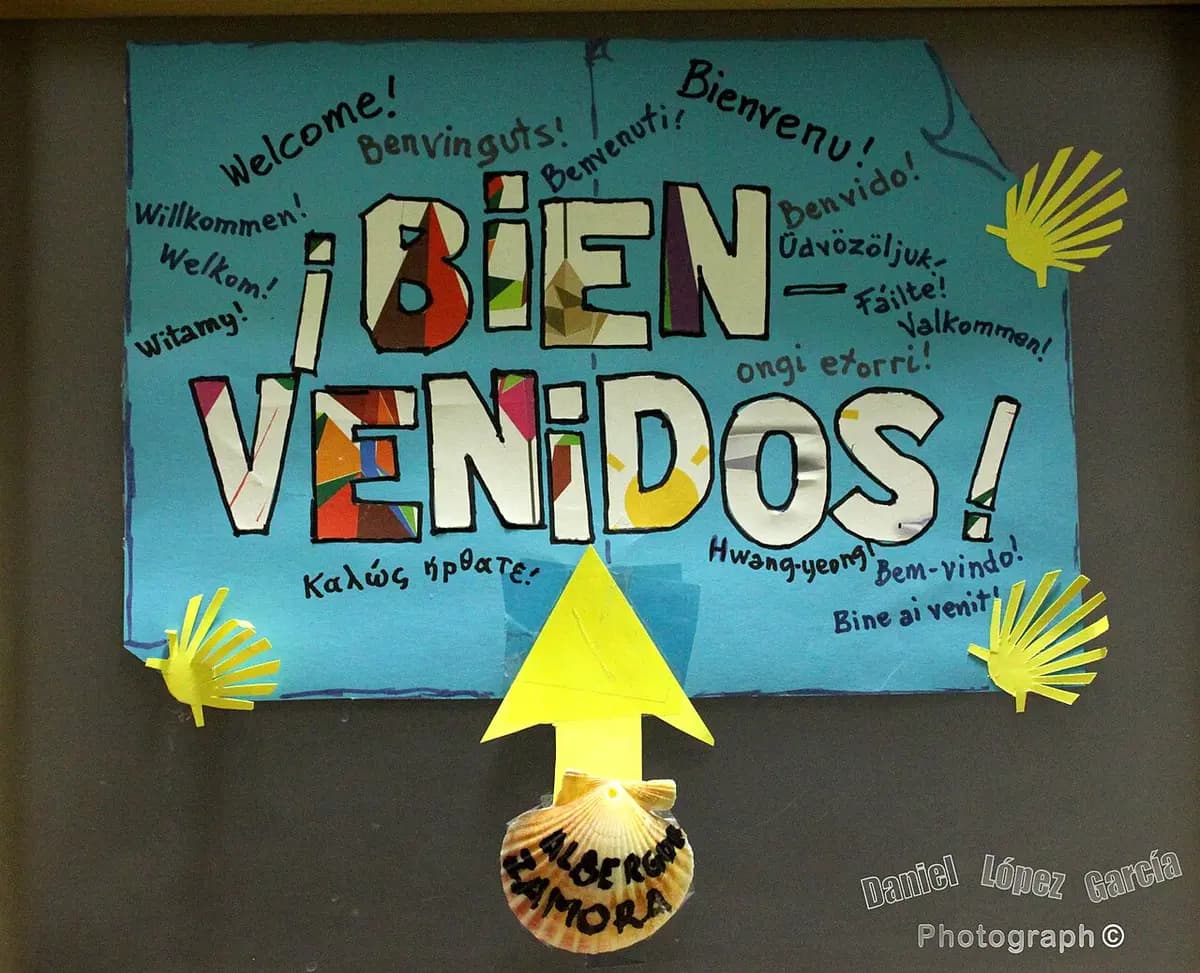
Multilingual welcome poster at the Zamora albergue (Spain), photo DnTrotaMundos, Wikimedia Commons, CC BY 3.0 licence; image converted to WebP and resized.
Paper, PDF or digital welcome book: which format for multilingual use?
For several languages, a digital welcome book is easier to keep up to date than a paper binder. On paper, you need one page per language, reprinting at every change of code or rule, and a check that each version is current. A welcome book accessed by QR code shows the language the traveller has chosen and is updated in one go. Our comparison of paper or digital welcome books details the costs and limits of each format.
At Majordia, the welcome book content is translated automatically and shown in the traveller's language among six languages: French, English, German, Spanish, Italian and Dutch (multilingual feature). The translation is automatic: proofread sensitive instructions before publishing them. You can see how it all works on the digital welcome book page and compare plans on the Pricing page.
The welcome book is part of a broader journey. For a foreign traveller arriving late, self check-in and a clear welcome book in their own language save a phone call at dinner time. If you host European guests in numbers, the article on tourist visitor numbers in France in 2026 provides season-by-season context. For guests coming from the United Kingdom, see also our guide to holiday lets in England.
What should a multilingual welcome book contain?
A multilingual welcome book contains the same sections as the French one, in the same order, so that every traveller finds the information in the same place. In order of priority:
- Arrival and access: exact address, code or key box, arrival time, contact number.
- Wi-Fi: network name and password, shown exactly as they are.
- How the property works: heating, air conditioning, washing machine, hob, waste sorting.
- House rules: quiet hours, smoking, pets, number of guests.
- Emergencies: useful emergency numbers and the manager's contact.
- Departure: time, keys, condition of the property.
- Local guide: restaurants, shops, activities, transport, favouring concrete details.
Check names and units: temperatures, times in 24-hour or 12-hour format, day of the week. An instruction such as "bins on Tuesday" stays clear in every language if the day is written out in full.
How do you find out which languages your travellers use?
The most reliable approach is to look at your bookings: the language of the traveller's message, the country shown on the platform and the languages they use to write to you. Do this review over twelve months and count travellers by language. Languages that exceed roughly one traveller in ten deserve a dedicated version; the others can stay in English.
Public data serve as a cross-check: if Insee reports, for example, that the Dutch account for a very large share of campsite nights, and you rent near a campsite, a Dutch version has a good chance of being read. Conversely, if your property is in the heart of a big city, English and Spanish will probably come before Dutch.
Key takeaways
Information
- Start with French and English, then add the languages of your actual travellers.
- According to Insee (summer 2026), Americans and Britons account for about 26% of non-resident hotel nights; the Dutch and Germans account for about 32% and 26% of non-resident campsite nights (Majordia calculation).
- The welcome book must be bilingual from 3 stars for a rated furnished rental (Atout France, inspection guide of January 2026).
- Have the sensitive instructions proofread: access, safety, emergencies, house rules.
- A digital welcome book is easier to keep up to date in several languages than a paper one.
FAQ
Which languages should a welcome book offer?
French and English are the basis. Then add German and Dutch if you are near campsites or family areas, and Spanish and Italian for a city-break clientele. Rely on the actual nationality of your travellers over twelve months.
Does the welcome book have to be in English?
Not necessarily. The rating framework requires a bilingual welcome book from 3 stars, without naming the language. English remains the most common choice because, according to Eurostat, it is the most widespread foreign language in Europe.
Is machine translation enough?
It is enough for most of the content, provided you proofread the critical passages: access, codes, safety, quiet hours, emergencies. An error on these points can cause an incident or a dispute, unlike a slightly clumsy neighbourhood description.
How many languages can you offer with Majordia?
The welcome book content is translated automatically and displayed in six languages: French, English, German, Spanish, Italian and Dutch, depending on the language chosen by the traveller. Proofread sensitive instructions before publishing.
Do you also need to translate your Airbnb or Booking listing?
A machine-translated listing still needs checking. Proofread at least the title, the house rules and the main amenities, and adapt your booking message to the traveller's language.
Do Insee statistics apply to Airbnb rentals?
No, not directly. Insee measures hotels, campsites and other collective tourist accommodation. The figures give an order of magnitude of the nationalities travelling in France, to be supplemented by an analysis of your own bookings.
Setting up your multilingual welcome book
Choosing your languages is a decision of a few minutes if you start from your bookings: note the nationalities, add the language that exceeds roughly one traveller in ten, proofread the sensitive instructions and publish. With the Majordia digital welcome book, a single piece of content is shown in six languages and stays up to date in one place; the Pricing page details the plans.
Image credits. Cover: people in front of neon signs displaying greetings in several languages, photo by Leon Hu, Unsplash, Unsplash licence. Illustration: Méribel sign, photo by DimiTalen (CC0 1.0), via Wikimedia Commons; image converted to WebP format and resized. Additional illustration: Zamora albergue poster, photo DnTrotaMundos (CC BY 3.0), via Wikimedia Commons.
Sources. Insee, Focus no. 387, Summer 2026 tourist season; Atout France, inspection guide for furnished tourist rentals; Eurostat, nights booked via platforms in 2025; Eurostat, Foreign language skills statistics; TourMaG, 2025 international tourism review.


